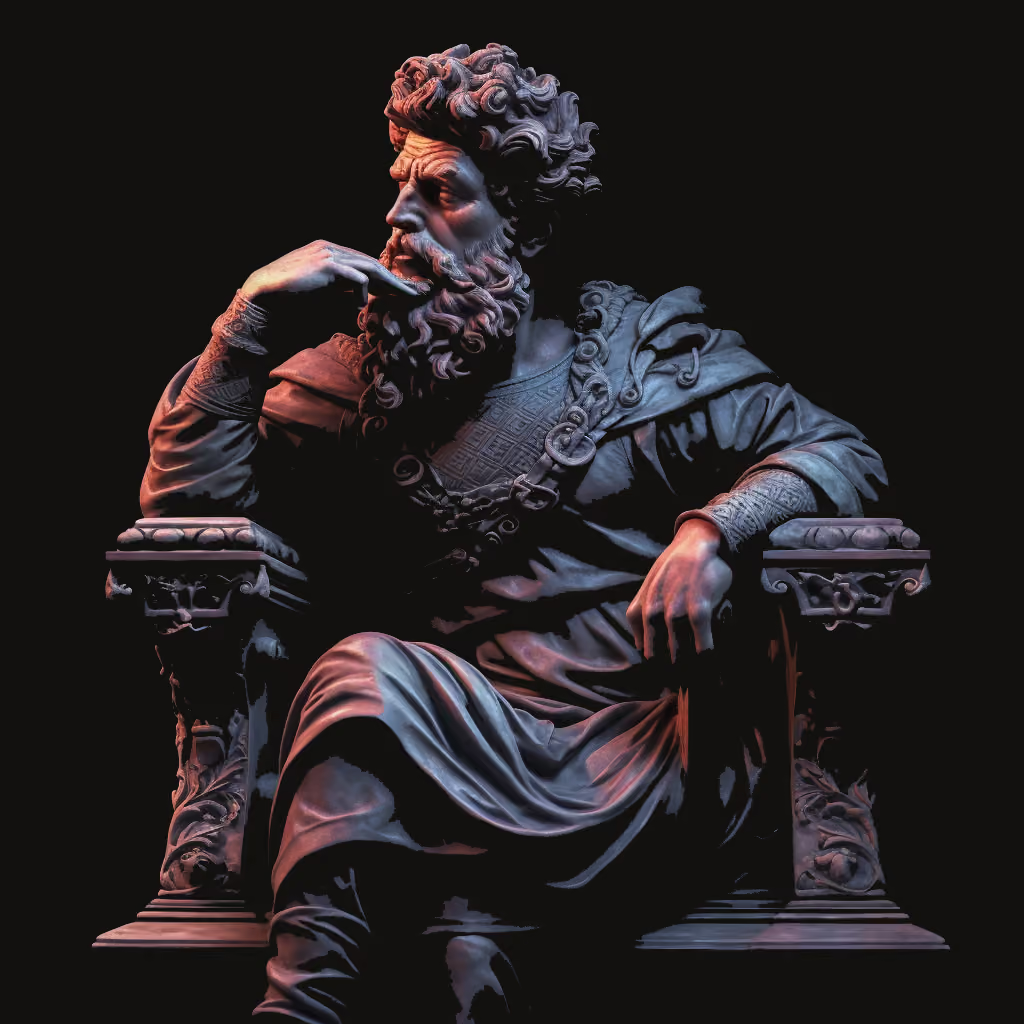
Meditations: Book III
The Transience of All ThingsBook III of the Meditations deepens the themes introduced in Book II, particularly the urgency that comes from the awareness of mortality. Where Book II opened with the morning meditation on dealing with other people, Book III turns inward, examining the fleeting nature of life itself and the consequent need to live each moment with purpose and virtue.
The Speed of Passing (3.1–3.3)
Marcus opens Book III with a series of reflections on how quickly everything passes. "We should not act and speak as if we were asleep," he writes. Life is short, and most of it is consumed by sleep, childhood, and the various distractions that pull us away from philosophy. The time remaining is precious and must not be squandered.
His method here is what the Stoics called premeditatio malorum — the premeditation of evils. By vividly imagining the loss of everything we value, we strip those things of their power to disturb us when they are actually taken away. More importantly, we cultivate gratitude for what we have while we have it.
The Inner Sanctuary (3.4–3.6)
Marcus introduces the image of the mind as a sanctuary that must be kept pure. "Retire into yourself," he writes. "The ruling faculty is sufficient for itself when it does what is right." He urges himself to live with a kind of moral urgency, as if each day were his last — not in a frantic, hedonistic sense, but with the calm seriousness of someone who knows that time is limited.
This is one of the most frequently misunderstood aspects of Stoicism. Marcus is not advocating for a grim, joyless existence. He is saying that the awareness of death should strip away the trivial and reveal what is truly important. "If you have seen the present, you have seen all things," he writes, "from eternity to eternity."
A man should always have these two rules ready: first, to do only what the reason of your ruling faculty suggests for the service of mankind; second, to change your opinion when someone corrects you and convinces you of your error. — Marcus Aurelius, Meditations 3.4
The Pursuit of Cleanliness (3.7–3.10)
Marcus reflects on the beauty of things that are complete in themselves and follow their own nature. A ripe fruit, a loaf of bread, a cracked vase — each has its own kind of beauty when seen rightly. The lesson is that we should not desire things to be other than what they are. The crack in the vase is not a flaw; it is a sign of the vase's history and its use.
This is a profound insight that anticipates modern mindfulness and acceptance-based approaches. Marcus is not arguing for passive resignation, but for a clear-eyed perception of reality that frees us from unnecessary suffering. The crack in the vase is not a problem unless we insist that the vase should be unblemished.
Modern Relevance
Book III's emphasis on the shortness of life and the importance of living with intention resonates powerfully in our age of distraction. Marcus' advice to "not act or speak as if you were asleep" is a direct challenge to the autopilot mode in which many of us live our lives. The practice of premeditatio malorum has been adopted by modern cognitive-behavioural therapists as a technique for managing anxiety and building resilience.
The image of the cracked vase — finding beauty in imperfection — has become particularly influential, finding echoes in the Japanese aesthetic of wabi-sabi and in modern acceptance-based therapies. Marcus teaches us that peace comes not from arranging the world to our liking, but from seeing it as it is.
The Text of Book III
The following is a modernised adaptation of the George Long translation.
3.1
We should not act and speak as if we were asleep. Even in our waking hours, we are often as if we were dreaming. We should not spend our lives in idle speculation, but in action that serves the common good.
3.2
A man should be upright, not held upright. Let your character be your own, not borrowed from others.
3.3
Do not waste the remaining part of your life on thoughts about others, unless you are reflecting on the common good. Your time is limited, and every moment spent on idle thoughts is a moment stolen from the pursuit of virtue.
3.4
A man should always have these two rules ready: first, to do only what the reason of your ruling faculty suggests for the service of mankind; second, to change your opinion when someone corrects you and convinces you of your error. But the change of opinion should come from a conviction that it is right or for the common good, not merely because it is pleasant or popular.
3.5
Does the name of Socrates or any other wise man still live? The fame of a great name is but a shadow. What is eternal is virtue itself, not the memory of those who possessed it.
3.6
The pride of those who are not philosophers is a heavy burden. They think they are wise, but they do not even know what wisdom is.
3.7
Do not be disturbed by the future. You will face it, if you need to, with the same reason that you apply to the present.
3.8
Everything is soon swallowed up in the vastness of time. The things that exist now will soon be gone, and the things that will exist after them will be gone as well.
3.9
The work of a philosopher is simple and modest. Do not be led astray by empty words or the opinions of the crowd.
3.10
Look at things as they truly are, stripped of their coverings. See the naked reality of everything, and do not be deceived by appearance.
3.11
The life of man is short, and the time we have is uncertain. Let us use it well, for the service of others and the cultivation of our own virtue.
3.12
If you have seen the present, you have seen all things, from eternity to eternity. For all things are of the same nature, and take their form from the same source.
3.13
Do not fear death, but welcome it as one of the things that nature wills. As you have been born, so you must die. The time between is your own.
3.14
The mind that is free from passions is a fortress. Nothing can storm it, nothing can break it. A person who has taken refuge in this fortress is safe.
3.15
Everything is opinion. Your opinion is within your power. Take away your judgment, and you take away the pain.