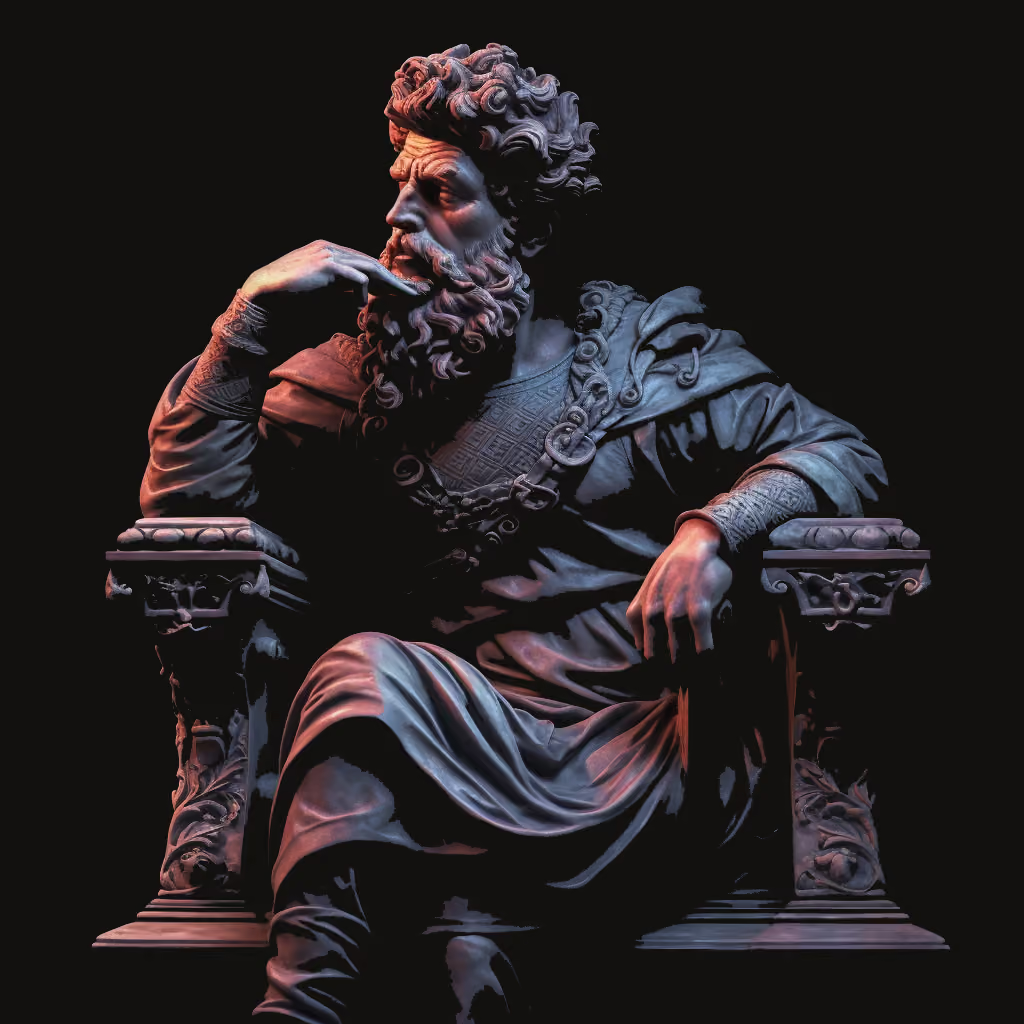
Meditations: A Reader's Guide
The Personal Notebook of a Philosopher EmperorThe Meditations of Marcus Aurelius is the most intimate document of ancient philosophy that has come down to us. It is not a polished treatise, nor a letter addressed to a specific audience, nor a lecture delivered to students. It is a set of private notes — what the Greeks called hypomnêmata — written by a sitting Roman emperor to himself, in the last decade of his life, during military campaigns along the Danube frontier.
Marcus wrote in Greek, the language of philosophy, not Latin, the language of Roman administration. The work is composed of twelve books (or "rolls"), each containing a series of disconnected reflections, aphorisms, and self-exhortations. There is no systematic argument; the same themes recur again and again. This is not a flaw but a feature — it is a man talking to himself, reminding himself of what he believes, in the face of exhaustion, war, plague, and the imminence of death.
Waste no more time arguing about what a good man should be. Be one. — Marcus Aurelius, Meditations 10.16
The Manuscript Tradition
The Meditations survived through a single manuscript tradition. The oldest surviving copy is the Codex Vaticanus Graecus 1950, dating from the 10th or 11th century, which was unknown in the West until the 16th century. The first printed edition was published in 1558 by the Swiss scholar Johann Oporinus. Since then, it has been translated into virtually every language and has never been out of print — a testament to its enduring power.
Key Themes
Several themes recur throughout the Meditations with striking persistence:
- The transience of all things — Marcus never tires of reminding himself that everything passes: fame, power, wealth, the body itself. "Soon you will have forgotten everything, and soon everything will have forgotten you."
- The inner citadel — The mind is inviolable. No external event can harm it unless it gives assent. "Things stand outside the door, on their own, not knowing anything and not saying anything. What is it that pronounces judgment on them? The ruling faculty."
- Providence or atoms — Marcus considers two possibilities: either the universe is governed by a rational providence, or it is a random swirl of atoms. Either way, he can act virtuously. This is a key Stoic move: the truth of physics does not change the imperative of ethics.
- Cooperation and community — "We are made for cooperation, like feet, like hands, like eyelids." Marcus repeatedly emphasises the social nature of human beings and our duty to work together.
- Mortality — The awareness of death pervades the Meditations. Marcus urges himself to live each moment as if it were his last — not in a frantic, hedonistic sense, but with the gravity and seriousness appropriate to a finite life.
Notable Translations
Several English translations of Meditations are widely available, each with distinct strengths:
- George Long (1862) — The classic Victorian translation, now in the public domain. Its language is stately but sometimes archaic. The version used on this site is a modernised adaptation of Long's translation.
- Maxwell Staniforth (1964) — A readable modern translation with a helpful introduction.
- G. M. A. Grube (1977) — Clear and idiomatic, with a useful index.
- Robin Hard (1997) — A reliable Oxford World's Classics edition with excellent notes.
- Gregory Hays (2002) — The most popular modern translation. Crisp, contemporary, and highly readable. Often recommended for first-time readers.
- Martin Hammond (2006) — A Penguin Classics edition with a fine introduction and extensive notes.
- C. R. Haines (Loeb Classical Library) — The standard Greek-English facing edition for scholarly reference.
Explore the Books
Each book of the Meditations has its own character and emphasis. Below are guides to the first five books, with more to follow.
- Book I: Debts and Gratitude — Marcus records what he learned from his family, teachers, and mentors. A unique autobiographical document.
- Book II: Morning Reflections — The dawn meditation on dealing with difficult people and the reminder of mortality.
- Book III: The Transience of All Things — On the rapid passing of all things and the urgency of living virtuously.
- Book IV: The Inner Citadel — "Things stand outside the door, on their own." The mind as an inviolable fortress.
- Book V: Morning Work — Getting up to do the work of a human being and living in harmony with Nature.
- Books VI–XII — Coming soon.